
After several days of testing this filter kit, I thought I’d post a quick review since I wasn’t able to find any other reviews online. I also happen to own a Platypus GravityWorks and was interested to see how the two would compare, since they’re both two-bag systems that sell for roughly the same price.
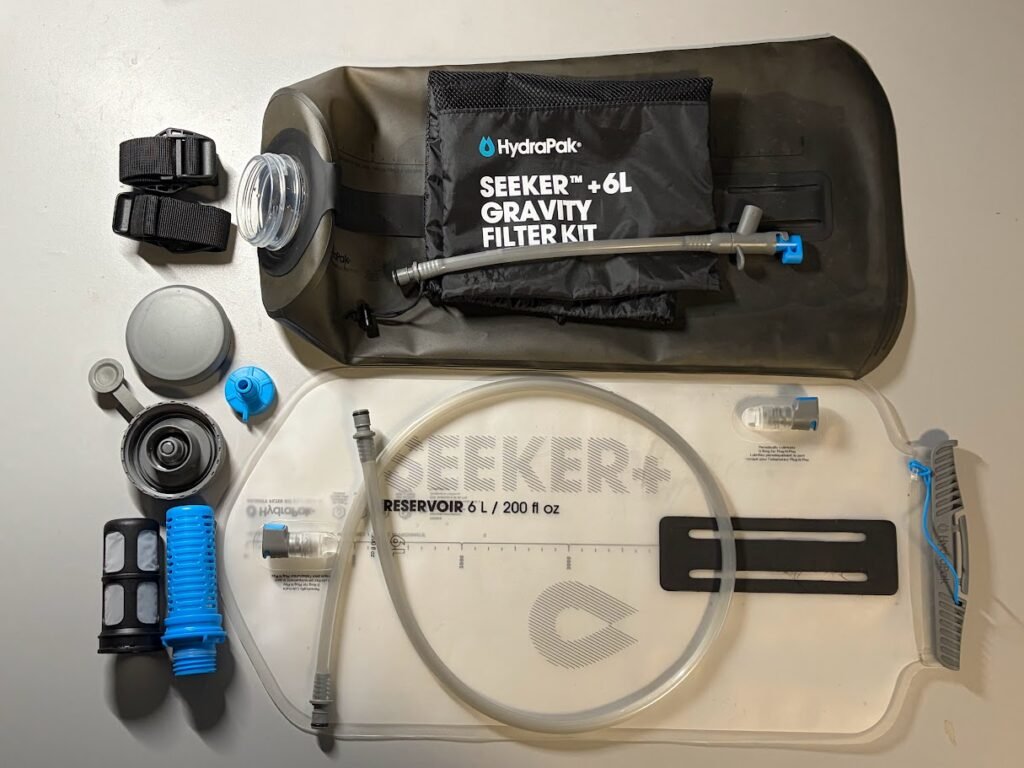
HydraPak calls this a Gravity Filter Kit and it definitely feels like a kit. Fully disassembled, the kit consists of 11 separate components: two hanging straps, two reservoirs, two hoses, two caps, a filter, a pre-filter, and a back flush adapter. Well, twelve components if you include the carrying sack.
It’s a little intimidating at first, but once I put everything together, it all made sense. The downside to having so many components, of course, is that there are more opportunities to lose something – and losing the wrong component could potentially render the filter useless.
Unlike the Platypus GravityWorks, which uses an inline filter with hoses on both ends, the Seeker uses a filter that sits inside the dirty-water reservoir, screwed directly to the inside of the cap.
One advantage of this setup is that it doesn’t have to be hung as high since there isn’t a filter dangling underneath on a hose. Another is that it allows for a pre-filter to be installed directly over the filter. The pre-filter snaps on and off and should increase the life of the filter, which is rated for 1,500L, while also reducing the frequency of backflushing.
Flow rate was quite impressive – comparable to, or possibly better than the GravityWorks, although I’d expect that from a new filter. When comparing the filter to the Katadyn Befree Gravity, another gravity filter with the filter element mounted inside the dirty-water reservoir, the Seeker’s filter itself is around 30% larger, which may help explain its fast flow rate.
One feature that really sets the Seeker apart is the Camp Tap, a spring loaded release valve. Because the Camp Tap is attached to a separate port on the clean-water bag, you can start using the filtered water while the rest is being processed.
Speaking of the clean-water bag, its ability to fully open for thorough cleaning is another great feature. Compare that to the GravityWorks reservoir, which only has a 28mm opening.
Specification wise, the Seeker claims 99.9999% filtration of bacteria, which is the same as the GravityWorks. It also claims 99.999% removal of protozoa, compared to 99.9% for the GravityWorks. Giardia is one of the more common waterborne pathogens of concern in the backcountry, so the higher protozoa rating is encouraging. However, these are manufacturer claims based on their respective testing, so real-world protection may vary.
The main drawback of the Seeker is its weight, which is around 35% heavier than the GravityWorks. As mentioned earlier, it’s also made up of more components. Realistically, you’ll need to disassemble it to put it away since the dirty-water reservoir doesn’t roll up easily with the filter mounted perpendicular of the roll. Compare that to the GravityWorks which rolls up easily since the hose attached filter can be repositioned.
And while the Camp Tap is excellent because it allows you to dispense water with one hand, there’s a small trade-off if you want hands free dispensing. You’ll have to lock the valve in the open position, at which point the water flows at full output.
Finally, the backflush procedure is more complicated than the GravityWorks in that it requires a separate bottle. To be fair, however, the pre-filter should reduce how frequently you’ll need to backflush.
The Seeker is an excellent, feature packed product and a worthy alternative to the GravityWorks. Those looking for a simple, lightweight two-bag system can’t go wrong with the time-tested GravityWorks. But if you’re willing to carrying a little more weight, the Seeker offers considerably more versatility and some genguinely useful features.